[SMM Analysis] Japan’s Crude Steel Output Falls Below 81 Million Tonnes: Labor Bottlenecks and Energy Cost Struggles Signal an “Era of Retrenchment” for a Traditional Manufacturing Power

Published: Jan 29, 2026 10:22
Source: SMM
In 2025, production across all categories of the Japanese steel industry declined compared to the previous year, with the sharpest drops recorded in Electric Arc Furnace (EAF) steel, Plate, and Sections and Bars. This broad contraction is largely attributed to a persistent labor shortage that has subdued domestic construction activity—a systemic challenge unlikely to be resolved in the short term due to the current work environment. Additionally, high energy costs and the ongoing relocation of manufacturing overseas continue to pressure domestic output, signaling that the industry is shifting away from a volume-based growth model.

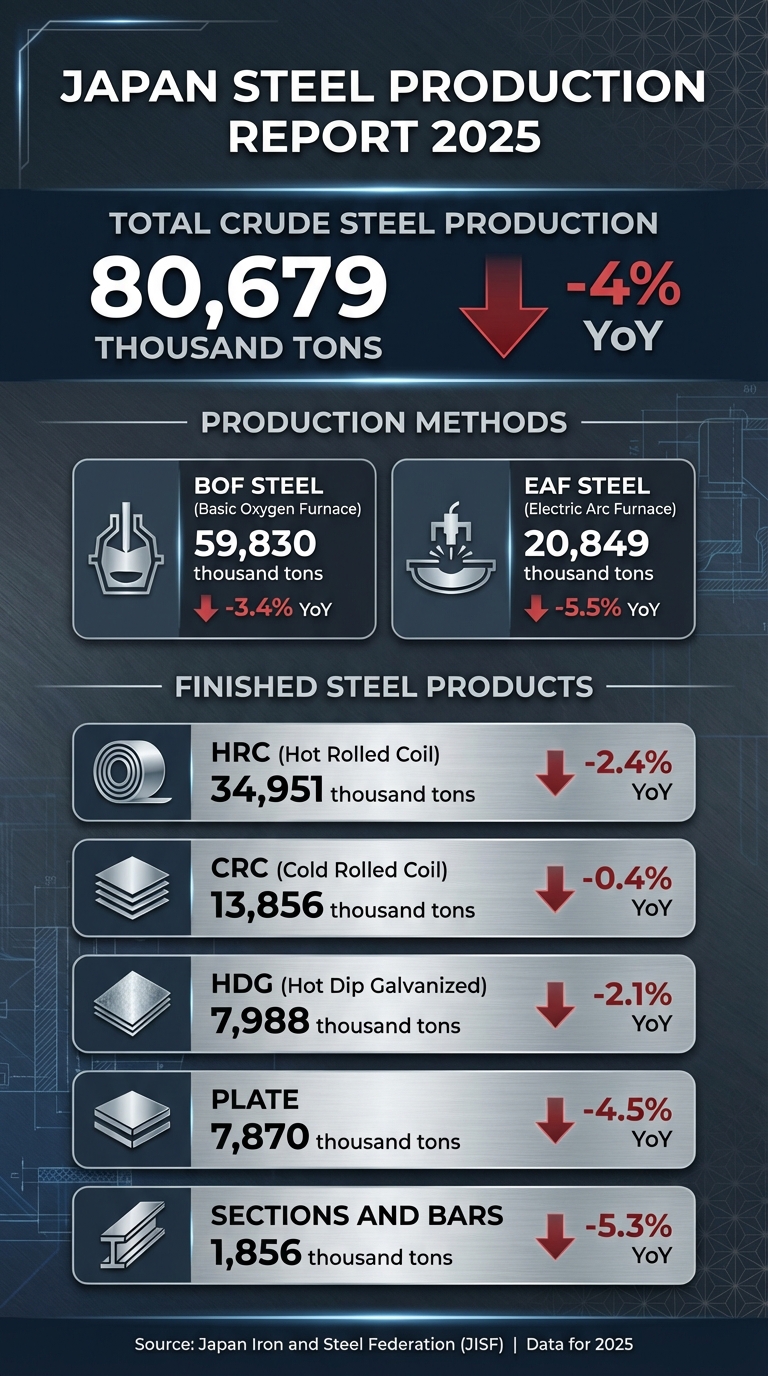
Japan's steel industry faced significant downward pressure throughout 2025. According to the latest data from the Japan Iron and Steel Federation (JISF), total crude steel production reached 80,679 thousand tonnes, marking a 4% year-on-year (YoY) decrease.


  • BOF Steel (Basic Oxygen Furnace): 59,830 thousand tonnes, ↓ 3.4% YoY.

  • EAF Steel (Electric Arc Furnace): 20,849 thousand tonnes, ↓ 5.5% YoY.


Finished Steel Products

  • Hot Rolled Coil (HRC): 34,951 thousand tonnes, ↓ 2.4% YoY.

  • Cold Rolled Coil (CRC): 13,856 thousand tonnes, ↓ 0.4% YoY.

  • Hot Dip Galvanized (HDG): 7,988 thousand tonnes, ↓ 2.1% YoY.

  • Plate: 7,870 thousand tonnes, ↓ 4.5% YoY.


Sections and Bars

  • 1,856 thousand tonnes, ↓ 5.3% YoY.


Summary and Analysis

In 2025, production across all categories of the Japanese steel industry declined compared to the previous year, with the sharpest drops recorded in Electric Arc Furnace (EAF) steel, Plate, and Sections and Bars. This broad contraction is largely attributed to a persistent labor shortage that has subdued domestic construction activity—a systemic challenge unlikely to be resolved in the short term due to the current work environment. Additionally, high energy costs and the ongoing relocation of manufacturing overseas continue to pressure domestic output, signaling that the industry is shifting away from a volume-based growth model.

Data Source Statement: Except for publicly available information, all other data are processed by SMM based on publicly available information, market communication, and relying on SMM‘s internal database model. They are for reference only and do not constitute decision-making recommendations.

For any inquiries or to learn more information, please contact: lemonzhao@smm.cn
For more information on how to access our research reports, please contact:service.en@smm.cn
Related News
[SMM Shanghai HRC Inventory] Shanghai inventory saw a buildup this week on a MoM basis.
3 hours ago
[SMM Shanghai HRC Inventory] Shanghai inventory saw a buildup this week on a MoM basis.
Read More
[SMM Shanghai HRC Inventory] Shanghai inventory saw a buildup this week on a MoM basis.
[SMM Shanghai HRC Inventory] Shanghai inventory saw a buildup this week on a MoM basis.
Shanghai HRC inventory totaled 347,100 mt this week, up 14,300 mt MoM, an increase of 4.30%; down 10.95% YoY on a Gregorian calendar basis, but up 17.94% YoY on a lunar calendar basis.
3 hours ago
[SMM Iron & Steel] Australia's Pilbara Ports Reopen After Cyclone Mitchell
4 hours ago
[SMM Iron & Steel] Australia's Pilbara Ports Reopen After Cyclone Mitchell
Read More
[SMM Iron & Steel] Australia's Pilbara Ports Reopen After Cyclone Mitchell
[SMM Iron & Steel] Australia's Pilbara Ports Reopen After Cyclone Mitchell
On February 8, 2026, the Pilbara Port Authority resumed operations at Port Hedland, the world’s largest iron ore export hub, following the passage of Cyclone Mitchell. Other major terminals, including Ashburton, Cape Preston West, and Dampier, resumed operations on February 9. While berths were cleared as a safety precaution on February 6, the quick resumption of activity has eased immediate concerns over a significant disruption to February shipment volumes for BHP and Rio Tinto.
4 hours ago
[SMM Iron & Steel] India Commits to $500 Billion Purchase of US Energy and Coking Coal
4 hours ago
[SMM Iron & Steel] India Commits to $500 Billion Purchase of US Energy and Coking Coal
Read More
[SMM Iron & Steel] India Commits to $500 Billion Purchase of US Energy and Coking Coal
[SMM Iron & Steel] India Commits to $500 Billion Purchase of US Energy and Coking Coal
The White House announced on February 6, 2026, that India has committed to purchasing $500 billion worth of US energy commodities, including coking coal, aircraft parts, and technology over the next five years. This strategic agreement aims to secure a stable supply of high-quality metallurgical coal for India’s expanding blast furnace capacity, which is targeting a national output of 300 million tonnes by 2030.
4 hours ago